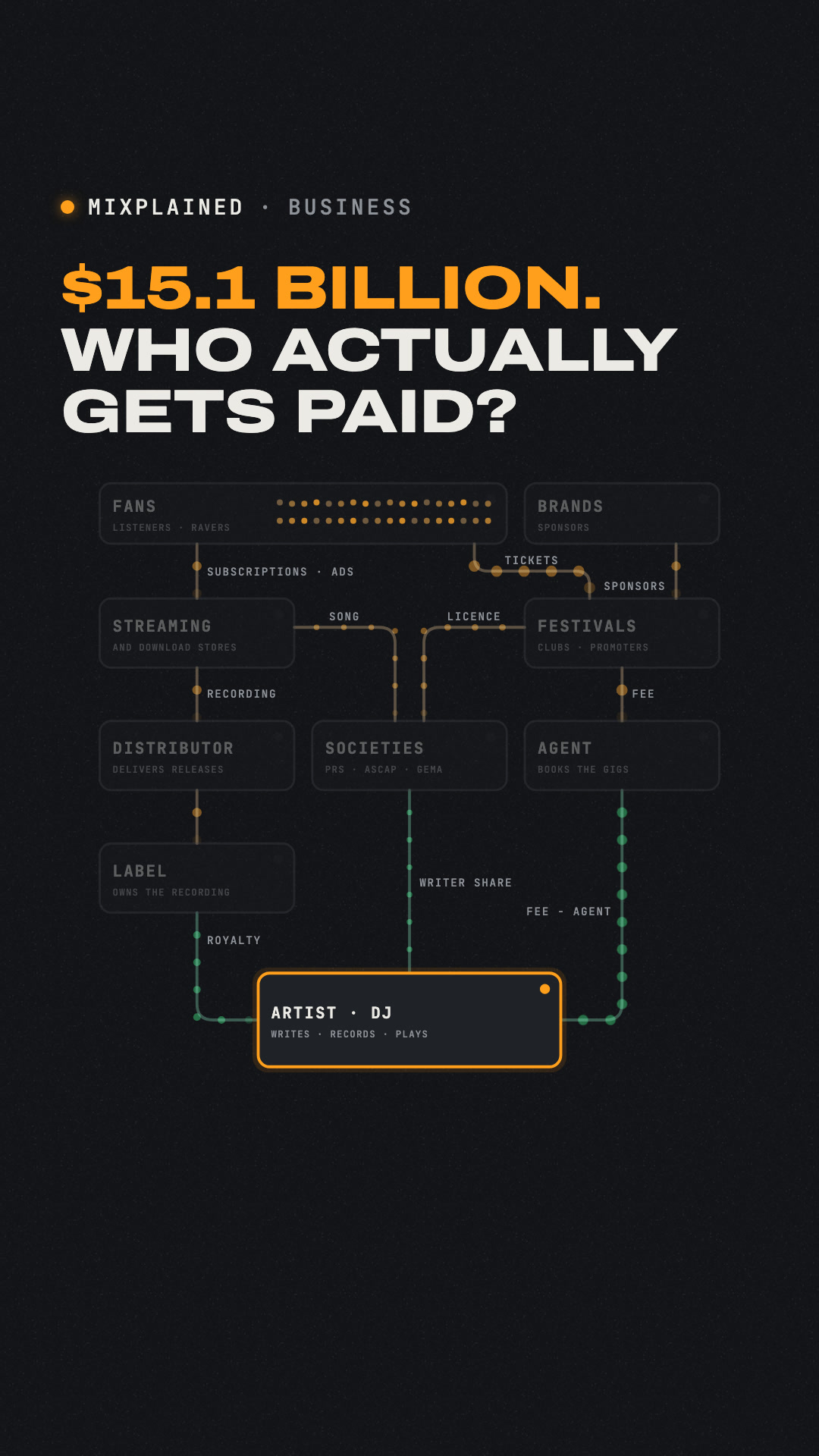
Labels, distributors, Spotify, collecting societies, promoters and agents: how the $15.1 billion electronic music business fits together, where a stream's money goes, and why most DJs earn on stage.
Records build the crowd. Gigs pay the rent.
Facts
- The global electronic music industry was worth $15.1 billion in 2025, up 7 % (IMS Business Report 2025/26, written by MIDiA Research; IMS is majority-owned by Beatport). In the previous report's 2024 data, festivals and clubs were the largest revenue source.
- Spotify doesn't pay per stream: it pays roughly two-thirds of its net music revenue to rights holders, shared by each track's share of all streams – more than $11 billion in 2025. Since April 2024, a track needs at least 1,000 streams in 12 months to earn recording royalties.
- Every track carries two copyrights: the recording and the song. In the UK in 2021, about 53 % of streaming revenue went to the recording side, 15 % to publishing and 32 % stayed with the service (Competition and Markets Authority).
- Royalties in new major-label deals averaged 23.3 % in the UK in 2021 (CMA); many independent labels split the net profit 50/50 instead (Musicians' Union). A distributor delivers releases to the stores for a yearly fee or a cut.
- UK promoters pay PRS about 4 % of a concert's box office and 2.5–2.7 % at festivals, and PRS has used fingerprinting to identify DJ sets in licensed venues since 2018. Festival promoters typically pay artists a fixed fee; agents usually take 10–15 %.
- In an IMS survey of DJs (2024), live shows were the biggest source of income for most; in the UK, 81 % of producers earn less than 10 % of their income from royalties (NTIA, 2026).
Sources
- IMS Electronic Music Business Report 2025/26 (news post) · International Music Summit (majority-owned by Beatport) checked 6 October 2026
- Mark Mulligan: IMS electronic music business report 2025/6 (MIDiA Research, 2026) · MIDiA Research checked 6 October 2026
- Billboard: What was the electronic music industry worth this year? 7 takeaways from the 2026 IMS Business Report · Billboard checked 6 October 2026
- Music Week: IMS Business Report 2025 – global electronic music industry valued at $12.9 billion · Music Week checked 6 October 2026
- Resident Advisor: Value of global dance music industry grows to $11.8 billion, IMS Business Report finds (2024) · Resident Advisor checked 6 October 2026
- Spotify Loud & Clear: FAQ · Spotify checked 6 October 2026
- Spotify for Artists support: Royalties · Spotify checked 6 October 2026
- Spotify for Artists: Modernizing our royalty system (2023, updated 2024) · Spotify checked 6 October 2026
- Spotify Loud & Clear: Takeaways (2026) · Spotify checked 6 October 2026
- Competition and Markets Authority: Music and streaming market study, final report – executive summary (2022) · Competition and Markets Authority (UK) checked 6 October 2026
- Musicians' Union: Specimen recording agreement · Musicians' Union (UK) checked 6 October 2026
- Judge Jules (Jules O'Riordan, Sheridans): Royalty types (MusicGurus) · MusicGurus checked 6 October 2026
- Judge Jules: Assignment or licence – what's the difference? (MusicGurus) · MusicGurus checked 6 October 2026
- Musicians' Union: Aggregator digital distribution services · Musicians' Union (UK) checked 6 October 2026
- DistroKid: Plans and pricing · DistroKid checked 6 October 2026
- CD Baby: Pricing · CD Baby checked 6 October 2026
- Beatport support: As a label, how do I sell my tracks on Beatport? · Beatport checked 6 October 2026
- ASCAP: About us · ASCAP checked 6 October 2026
- PRS for Music: Live royalties · PRS for Music checked 6 October 2026
- Musicians' Union: How to report live performances to PRS for Music · Musicians' Union (UK) checked 6 October 2026
- Music Week: PRS live tariff to rise to 4%, lower festival rate introduced (2018) · Music Week checked 6 October 2026
- Billboard: Songs in DJ sets are notoriously hard to track – how a Dutch rights organization is paying royalties (2023) · Billboard checked 6 October 2026
- The Guardian: Musicians losing out on millions due to wrongly allocated UK royalties, new research finds (2025) · The Guardian checked 6 October 2026
- Live Nation Entertainment: Form 10-K for 2025 · Live Nation Entertainment (SEC filing) checked 6 October 2026
- AIP Jargon Buster for Promoting (Association of Independent Promoters, UK) · Association of Independent Promoters checked 6 October 2026
- HMRC Employment Income Manual EIM62810: performers' agents' fees · HM Revenue & Customs checked 6 October 2026
- MusicTech: Nearly half of DJs say gigs are harder to find and pay less post-Covid, per IMS business report (2024) · MusicTech checked 6 October 2026
- Music Week: NTIA – UK electronic music generated £2.5 billion in economic activity in 2025 (2026) · Music Week checked 6 October 2026
- Attack Magazine: The 1% reality – what the numbers tell us about DJ economics (2025) · Attack Magazine checked 6 October 2026
Figures: IMS 2025/26, Spotify, UK CMA (2021) and PRS. Deals vary by country and contract.
All sound is original: synthesised for the episode, no samples, no licensed tracks. The narrator’s voice is AI-generated. General information. Features differ by software, player and version – check your own manual. Read how facts are checked and corrected.
Script
$15.1 billion. Who actually gets paid? That's what electronic music was worth in 2025. Follow the money. It starts with a track. And every track has two copyrights: the recording, and the song. A label pays to release it, and owns or licenses the recording. Majors often pay the artist a fifth to a quarter. Many indies split the profit 50/50. A distributor gets it onto Spotify, Apple Music and Beatport, for a fee or a cut. Spotify doesn't pay per stream. About two-thirds of the money goes into a pot, split by share of streams. Under 1,000 streams a year? No recording royalties. The recording's share flows back through the label. The song's smaller share goes through societies like PRS. But the biggest slice is live. Fans buy tickets and drinks, and brands pay to sponsor. At festivals, DJs usually get a fixed fee, minus 10–15 % for the agent. And promoters pay the societies: at UK festivals, about 2.5 % of ticket money. But DJ sets are hard to track, so some venues listen in with fingerprinting. For most DJs, gigs are the main income, not streams. Releases rarely pay the rent. But they help get you booked. Records build the crowd. Gigs pay the rent. Follow for the next cue.
Sources last checked 6 October 2026.