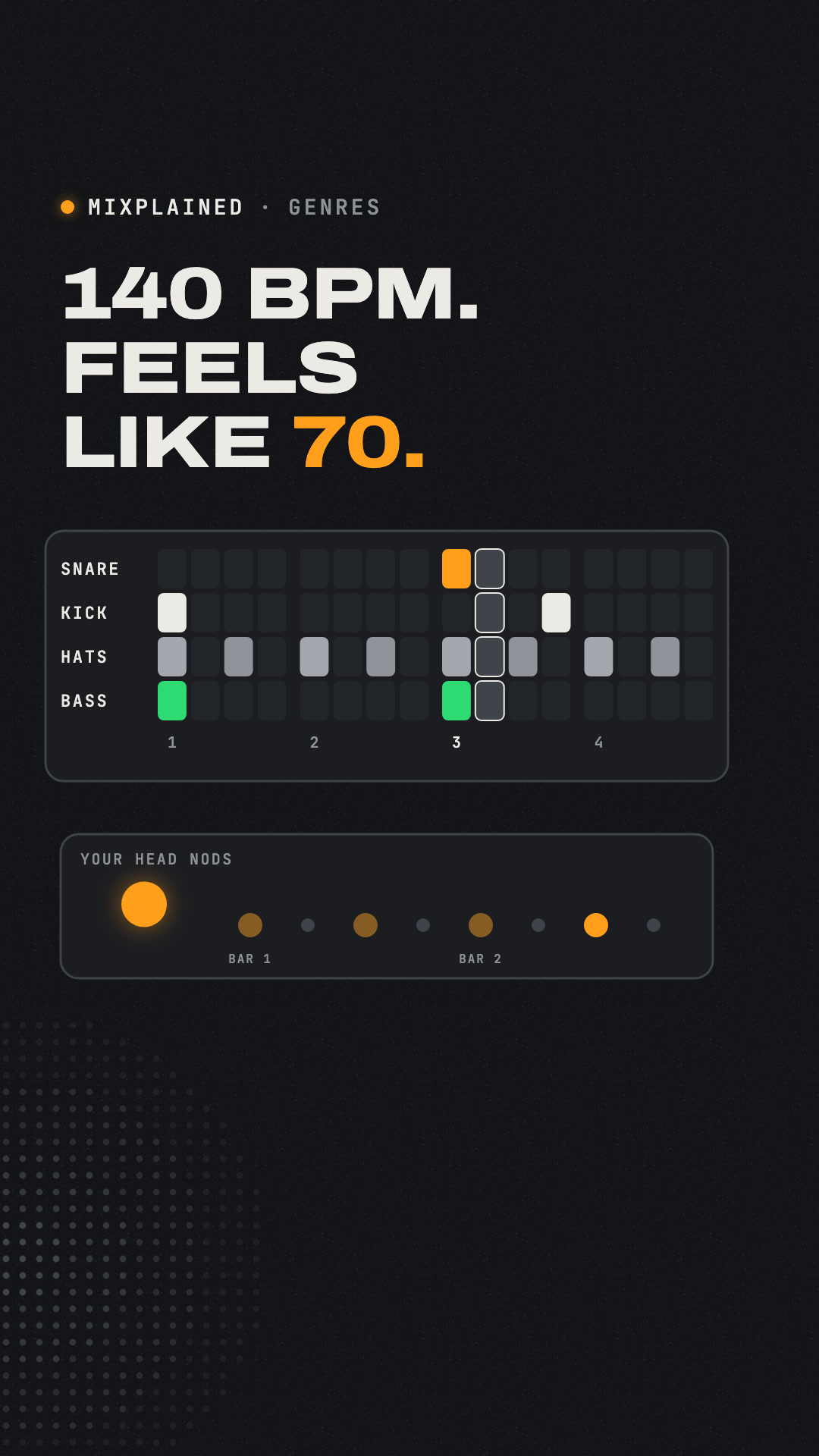
Half-time: move the snare from beats 2 and 4 to beat 3 and a 140 BPM beat feels like 70 – dubstep's trick, and why DJ software sometimes reads it as 70.
Tempo sets the grid. The snare sets the feel.
Facts
- Half-time doesn't change the BPM, the bar or the time signature: the kick and snare just land half as often – the snare on beat 3 instead of beats 2 and 4.
- At 140 BPM a beat lasts 428.6 ms and a bar 1.71 s (computed). In half-time the snare comes once a bar, so the kick-and-snare pulse drops from 140 to 70 a minute.
- Dubstep took shape in South London in the early 2000s around Croydon's Big Apple Records and the FWD>> night (started in Soho in 2001); it usually sits around 140 BPM with a half-time feel.
- A wobble is an LFO opening and closing a filter. Wobbly basses were already on early dubstep records; the loud, mid-range “brostep” style came later.
- People don't always agree on the beat: on fast tracks some listeners tap half as fast as the majority, and BPM software makes the same half-or-double “octave errors” – Serato's manual explains how to make a 140 BPM track read as 70.
- Trap and half-time drum & bass use the same trick: a fast grid with a slow-feeling kick and snare. One Croydon producer remembered that 140 was “apparently” FL Studio's default tempo.
Sources
- Open Music Theory: Drumbeats · Open Music Theory (VIVA Pressbooks) checked 6 October 2026
- de Clercq: Measuring a measure – absolute time and meter in pop/rock music (Music Theory Online, 2016) · Society for Music Theory checked 6 October 2026
- Ableton Learning Music: Backbeats · Ableton checked 6 October 2026
- Ableton Learning Music: Tempo and genre · Ableton checked 6 October 2026
- Attack Magazine: Drum programming – Mystik dubstep (2012) · Attack Magazine checked 6 October 2026
- DJ Mag: How Big Apple Records became the birthplace of dubstep · DJ Mag checked 6 October 2026
- Red Bull: Croydon, community, soundsystem culture – tracing the history of dubstep (2020) · Red Bull checked 6 October 2026
- Museum of Youth Culture: A brief history of early dubstep (2022) · Museum of Youth Culture checked 6 October 2026
- D'Errico: Going hard – bassweight, sonic warfare and the “brostep” aesthetic (Sounding Out!, 2014) · Sounding Out! checked 6 October 2026
- MusicRadar: How to build an LFO wobble bass (2024) · MusicRadar checked 6 October 2026
- Splice: What is dubstep music? History, artists and subgenres (2025) · Splice checked 6 October 2026
- London: Tactus ≠ tempo (Empirical Musicology Review, 2011) · Empirical Musicology Review checked 6 October 2026
- Levy: Improving perceptual tempo estimation with crowd-sourced annotations (ISMIR 2011) · International Society for Music Information Retrieval checked 6 October 2026
- Schreiber & Müller: Improving music tempo estimates using supervised learning (ISMIR 2017) · International Society for Music Information Retrieval checked 6 October 2026
- Serato DJ Pro manual: Analysis setting · Serato checked 6 October 2026
- Native Instruments: The track BPM detected by Traktor is half or twice the original BPM · Native Instruments checked 6 October 2026
- Native Instruments: How to make a trap beat (2022) · Native Instruments checked 6 October 2026
- Red Bull Music Academy: Artwork lecture (2011) · Red Bull Music Academy checked 6 October 2026
All sound is original: synthesised for the episode, no samples, no licensed tracks. The narrator’s voice is AI-generated. General information. Features differ by software, player and version – check your own manual. Read how facts are checked and corrected.
Script
140 BPM. Feels like 70. Here's a normal beat at 140: snare on two and four. Now move the snare to beat three, once a bar. Same tempo, hats still racing, but your head may nod half as often. Dubstep took shape in South London in the early 2000s, usually at 140, in half-time. Later the wobble got loud: an LFO sweeping a filter, in time with the beat. Even DJ software sometimes reads it as 70. Tempo sets the grid. The snare sets the feel. Follow for the next cue.
Sources last checked 6 October 2026.