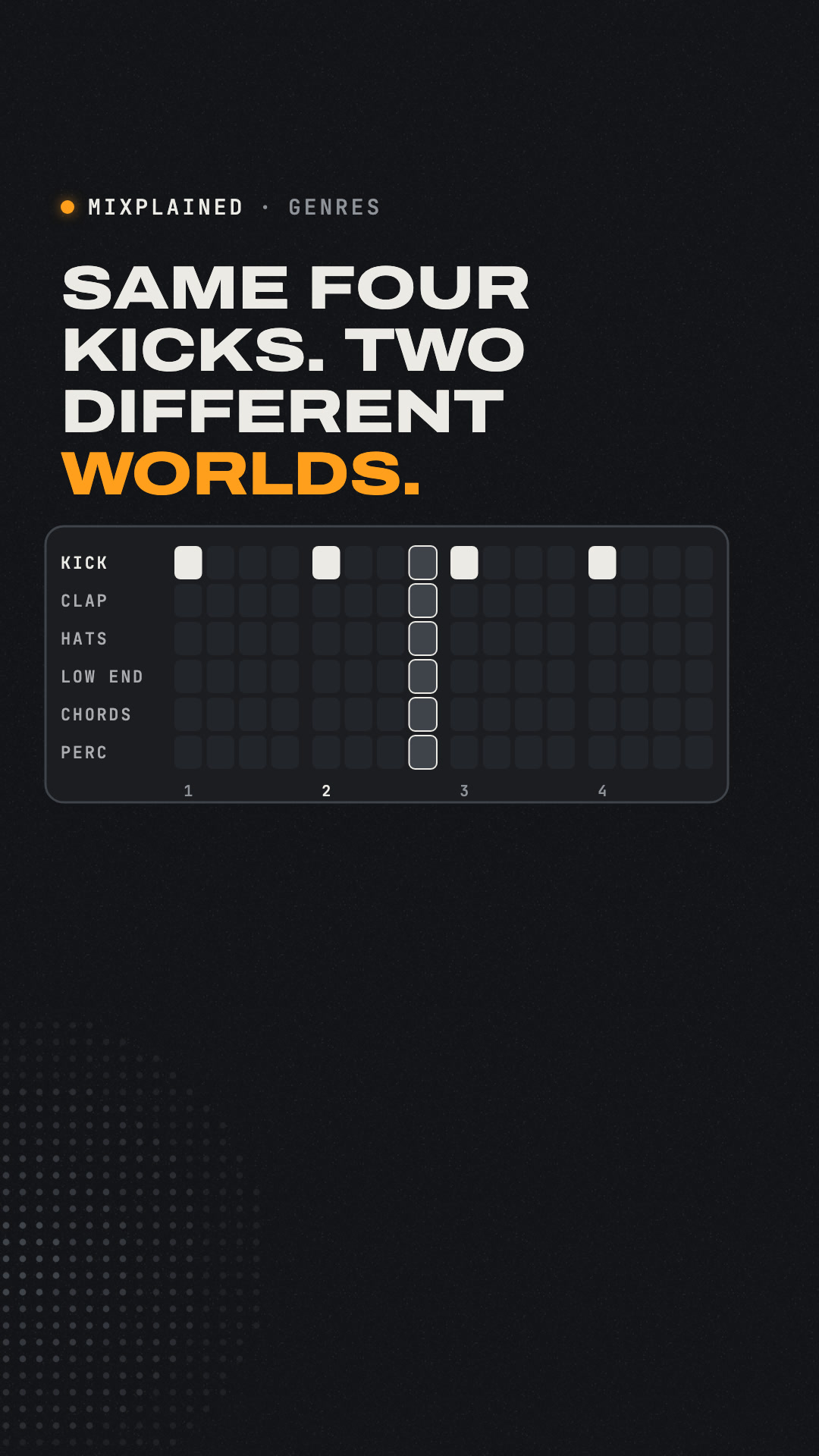
House vs techno: the same kick on every beat, two cities and two sounds – and the 1988 album that nearly called techno house.
House swings. Techno hypnotises.
Facts
- House grew out of Chicago's clubs in the early 1980s. Its name traces to the Warehouse, where Frankie Knuckles was the resident DJ: a record shop sold “Warehouse music”, later shortened to “house”.
- Techno took shape in Detroit in the mid-1980s around Juan Atkins, Derrick May and Kevin Saunderson. The name stuck after the 1988 UK compilation Techno! The New Dance Sound of Detroit – whose working title was The House Sound of Detroit.
- Both usually run in 4/4 with a kick on every beat and grew up on Roland drum machines, especially the TR-909.
- Typical tempos overlap: house about 115–130 BPM, techno about 120–140 BPM. Our demo plays house at 124 BPM and techno at 132.
- Tendencies, not rules: house leans on disco and soul, with swing, chords, piano and vocal hooks; techno is mostly instrumental and machine-like, built on repetition, percussion and texture.
- Frankie Knuckles called house “disco's revenge”.
Sources
- Encyclopaedia Britannica: House (Simon Reynolds) · Encyclopaedia Britannica checked 6 October 2026
- Encyclopaedia Britannica: Techno (Simon Reynolds) · Encyclopaedia Britannica checked 6 October 2026
- Encyclopaedia Britannica: Electronic dance music (Michaelangelo Matos) · Encyclopaedia Britannica checked 6 October 2026
- Encyclopaedia Britannica: The Warehouse · Encyclopaedia Britannica checked 6 October 2026
- Rietveld: Disco’s revenge – house music’s nomadic memory (Dancecult, 2011) · Dancecult: Journal of Electronic Dance Music Culture checked 6 October 2026
- Butler: Turning the beat around (Music Theory Online, 2001) · Society for Music Theory checked 6 October 2026
- Carnegie Hall, Timeline of African American Music: House · Carnegie Hall checked 6 October 2026
- Carnegie Hall, Timeline of African American Music: Detroit techno · Carnegie Hall checked 6 October 2026
- Detroit Historical Society: Atkins, Juan · Detroit Historical Society checked 6 October 2026
- The Guardian: Frankie Knuckles obituary (2014) · The Guardian checked 6 October 2026
- Red Bull Music Academy: Importes Etc. – the Chicago record store that popularized house (2016) · Red Bull Music Academy Daily checked 6 October 2026
- Red Bull Music Academy: Frankie Knuckles on the birth of house music (1995 interview) · Red Bull Music Academy Daily checked 6 October 2026
- Red Bull Music Academy: When techno was house (2017) · Red Bull Music Academy Daily checked 6 October 2026
- Red Bull Music Academy: Interview – Derrick May (2004) · Red Bull Music Academy Daily checked 6 October 2026
- Red Bull Music Academy: Interview – Neil Rushton (2000) · Red Bull Music Academy Daily checked 6 October 2026
- Roland: The TR-909 story · Roland checked 6 October 2026
- Ableton Learning Music: Tempo and genre · Ableton checked 6 October 2026
- MusicRadar: The definitive guide to producing house music in 2023 · MusicRadar checked 6 October 2026
- MusicRadar: The definitive guide to producing techno in 2023 · MusicRadar checked 6 October 2026
- MusicRadar: How to program 6 different four-to-the-floor grooves (2018) · MusicRadar checked 6 October 2026
- MusicRadar: How to create classic Chicago house spread piano chords (2017) · MusicRadar checked 6 October 2026
- Attack Magazine: Dark techno rumble (2019) · Attack Magazine checked 6 October 2026
- Discogs: Techno! (The New Dance Sound of Detroit), 10 Records, 1988 · Discogs checked 6 October 2026
Genres are tendencies, not rules: plenty of tracks sit in between.
All sound is original: synthesised for the episode, no samples, no licensed tracks. The narrator’s voice is AI-generated. General information. Features differ by software, player and version – check your own manual. Read how facts are checked and corrected.
Script
Same four kicks. Two different worlds. Both grew up on drum machines like the 909, usually with a kick on every beat. House: early-'80s Chicago, named after a club called the Warehouse. It leans on disco and soul: swing, chords, piano, vocal hooks. Usually 115 to 130 BPM. Techno: mid-'80s Detroit, mostly instrumental and machine-like. Built on repetition, texture and rumble, and often faster: up to about 140. The 1988 album that made the name stick was nearly called The House Sound of Detroit. House swings. Techno hypnotises. Follow for the next cue.
Sources last checked 6 October 2026.