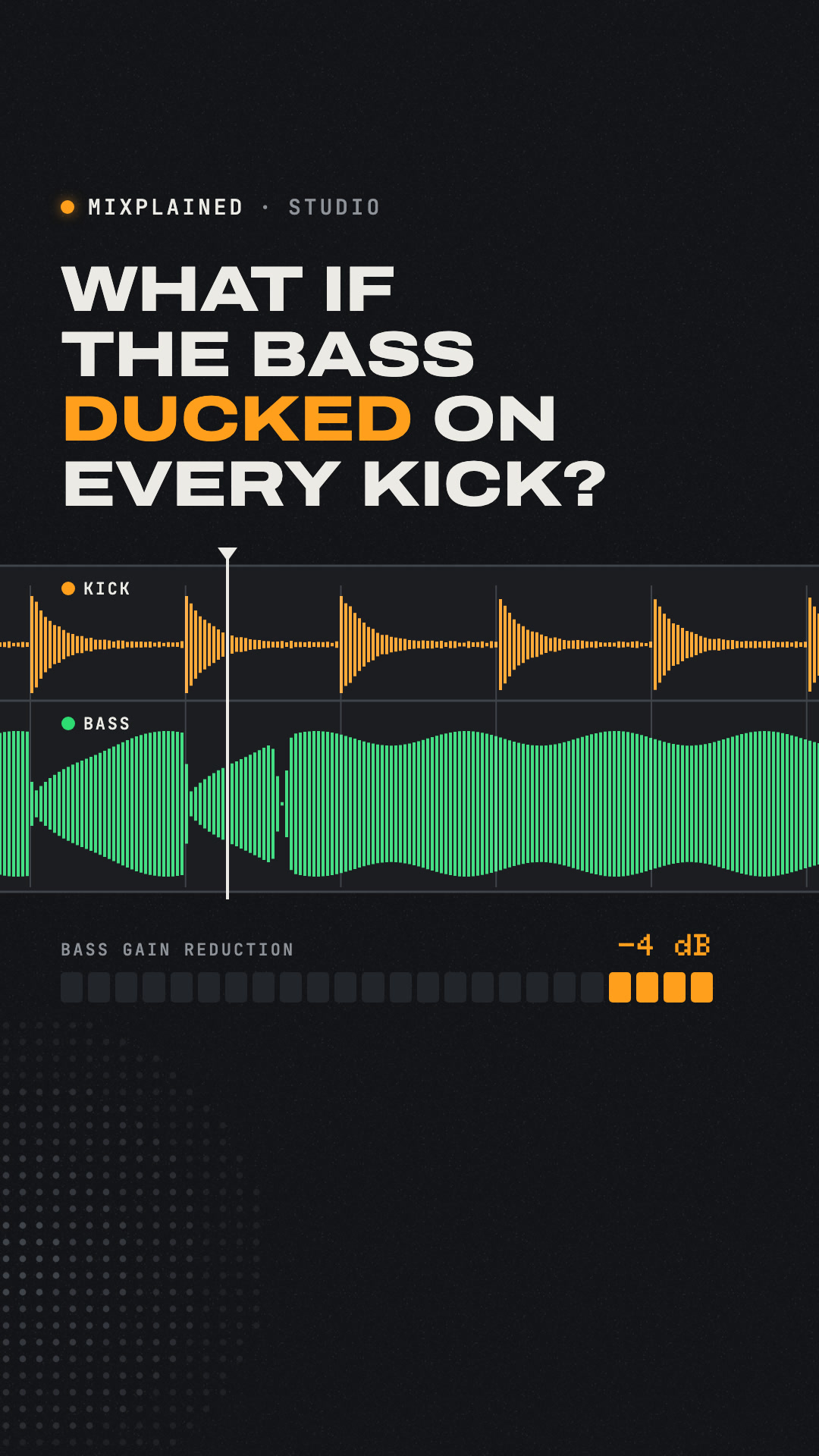
Sidechain compression: a compressor on the bass that listens to the kick, so the bass dips on every kick and swells back – the pump of dance music.
Duck the bass. Let the kick through.
Facts
- A sidechain input lets a compressor listen to one sound and turn down another: here the kick triggers it and the bass gets quieter. The trigger itself is never heard.
- Kick and bass both put their energy in the low end – Sound On Sound puts most of a kick's energy around 50–100 Hz – so they mask each other. Ducking the bass on each kick lets the kick's attack through.
- A dip of around 3 dB “still sounds pretty natural”; push it further and the groove audibly pumps. The release sets how the bass swells back, so producers tune it to the tempo (at 126 BPM kicks land about 476 ms apart, computed).
- Ducking is an old broadcast trick: the music dips automatically when a radio DJ or announcer speaks. In dance music the audible pump became a French house signature; Daft Punk's “One More Time” is widely cited as a classic example.
- Many producers now draw the dip with a tempo-synced volume shaper (LFOTool, VolumeShaper, Kickstart) instead of a compressor – and still call it “sidechain”.
Sources
- Ableton Live 12 Reference Manual: Compressor – sidechain parameters, sidechaining in dance music · Ableton checked 6 October 2026
- Apple Logic Pro User Guide: Use Compressor in Logic Pro for Mac · Apple checked 6 October 2026
- FabFilter Learn: Side chain compression (2022) · FabFilter checked 6 October 2026
- Cableguys: Nicky Romero Kickstart 2 manual · Cableguys checked 6 October 2026
- iZotope: US patent 10,763,812 – identifying and remediating sound masking (2020) · iZotope checked 6 October 2026
- Sound On Sound: Live side-chain compression (Len Sasso, 2010) · Sound On Sound checked 6 October 2026
- Sound On Sound: Mix tips for kick & bass (Paul White, 2011) · Sound On Sound checked 6 October 2026
- Attack Magazine: Ten tips for better basslines – sidechain compression (2013) · Attack Magazine checked 6 October 2026
- Computer Music: 13 ways to use sidechaining more effectively (2015) · MusicRadar / Computer Music checked 6 October 2026
- Sound On Sound: Side-chaining (Matt Houghton, 2008) · Sound On Sound checked 6 October 2026
- Apple MainStage effects: Ducker · Apple checked 6 October 2026
- Sound On Sound: Side-chain compression in Reason (Simon Price, 2008) · Sound On Sound checked 6 October 2026
- Ableton: Sidechain compression part 1 – concepts and history (2018) · Ableton checked 6 October 2026
- Future Music: Sidechaining, explained (2024) · MusicRadar / Future Music checked 6 October 2026
All sound is original: synthesised for the episode, no samples, no licensed tracks. The narrator’s voice is AI-generated. General information. Features differ by software, player and version – check your own manual. Read how facts are checked and corrected.
Script
What if the bass ducked on every kick? Kick and bass share the same low frequencies, so together they blur into mud. So put a compressor on the bass, and feed the kick into its sidechain input. Every kick, the bass dips, then the release lets it swell back. Time the release to the tempo: here, the kicks are 476 milliseconds apart. A few decibels just makes room. Push harder, and it pumps. Radio has long done the same: music ducking under a voice. Like this beat, under mine. Duck the bass. Let the kick through. Follow for the next cue.
Sources last checked 6 October 2026.